Two Chesterton quotes and a thought experiment

    In the section on George Bernard Shaw in Heretics, G.K. Chesteron writes: 
    
    "Mr. Bernard Shaw is always represented by those who disagree with  him, and, I fear, also (if such exist) by those who agree with him, as a capering humorist, a dazzling acrobat, a quick-change artist.  It is said that he cannot be taken seriously, that he will defend anything or attack anything, that he will do anything to startle and amuse.  All this is not only untrue, but it is, glaringly, the opposite of the truth; it is as wild as to say that Dickens had not the boisterous masculinity of Jane Austen.  The whole force and triumph of Mr. Bernard Shaw lie in the fact that he is a thoroughly consistent man.  So far from his power consisting in jumping through hoops or standing on his head, his power consists in holding his won fortress night and day.  
    
    He puts the Shaw test rapidly and rigorously to everything that happens in heaven or earth.  His standard never varies.  The thing which weak-minded revolutionists and weak-minded Conservatives really hate (and fear) in him, is exactly this, that his scales, such as they are, are held even, and that his law, such as it is, is justly enforced.  You may attack his principles, as I do; but I do not know of any instance in which you can attack their application.  If he dislikes lawlessness, he dislikes the lawlesness of the Socialists as much as that of Individualists.  If he dislikes the fever of patriotism, he dislikes it in Boers and Irishmen as well as in Englishmen.  If he dislikes the vows and bonds of marriage, he dislikes still more the fiercer bonds and wilder vows that are made by lawless love.  If he laughts at the authority of priests, he laughs louder at the pomposity of men of science.  If he condemns the irresponsibility of faith, he condemns with a sane consistency the equal irresponsibility of art. 

    He has pleased all the bohemians by saying that women are equal to men; but he has infuriated them by suggesting that men are equal to women.  He is almost mechanically just; he has something of the terrible quality of a machine.  The man who is really wild and whirling, the man who is really fantastic and incalculable, is not Mr. Shaw, but the average Cabinet Minister.  It is Sir Michael Hicks-Beach who jumps through hoops.  It is Sir Henry Fowler who stands on his head.  The solid and respectable statesman of that type does really leap from position to position; he is ready to defend anything or nothing; he is really not to be taken seriously.  I know perfectly well what Mr. Bernard Shaw will be saying thirty years hence; he will be saying what he has alway said.  If thirty years hence I meet Mr. Shaw, a reverent being with a silver beard sweeping the earth, and say to him, 'One can never, of course, make a verbal attack upon a lady,' the patriarch will lift his aged hand and fell me to the earth.  We know, I say, what Mr. Shaw will be saying thirty years hence.  But is there any one so darkly read in stars and oracles that he will dare to predict what Mr. Asquith will be saying thirty years hence?"

    In other words, those who did not understand Shaw thought that he was simply taking positions for the sake of novelty while in fact, he did have principles more than the politicians who would say anything based on where they thought the wind was blowing.  Interestingly enough, Chesterton had a similar experience shortly after he wrote Orthodoxy, the sequel to Heretics.  He writes in his autobiography:

    "But there did remain one rather vague virtue about the title [Orthodoxy], from my point of view; that it was provocative.  And it is an exact test of that extraordinary modern society that it really was provocative.  I had begun to discover that, in all that welter of inconsistent and incompatible heresies, the one and only really unpardonable heresy was orthodoxy.  A serious defece of orthodoxy was far more startling to the English critic than a serious attack on orthodoxy was to the Russian censor.  And through this experience I learned two very interesting things, which serve to divide all this part of my life into two distinct periods.  Very nearly everybody, in the ordinary literary and journalistic world, began by taking it for granted that my faith in the Christian creed was a pose or a paradox. 
    
    The mroe cynical supposed that it was only a stunt.  The more generous and loyal warmly maintained that it was only a joke.  It was not until long afterwards that the full horror of the truth burst upon them; the disgraceful truth that I really thought the thing was true.  And I have found, as I say, that this represents a real transition or border-line in the life of the apologists.  Critics were almost entirely complimentary to what they were pleased to call my brilliant paradoxes; until they discovered that I really meant what I said.  Since then they have been more combative; and I do not blame them."
    
    And this relates to a thought experiment I have wondered about occasionally.  If many of those from the past who saw themselves as progressives or reformers could come back and see the present day, what would they think?  I believe that pretty much all the ones who actually did have principles, such as George Bernard Shaw, would reconsider their views.  They would realize that what we have now is, despite what its proponents say, not a continuation of their principles, it is a going off the rails, a jettisoning of any principles at all.  

    The inflection point seems to have occurred around the late 1960s, when the Old Left (primarily focused on economics and of which Shaw was a part) transtitioned into the New Left focusing on constantly mutating means subversion.  And so, where we are now, and increasingly so, is not a development from the past, it's a going off the rails.  A replacement of what came before with what is dishonestly claimed to be its continuation.  
A Fable from Aesop

    The Hawk, the Kite, and the Pigeons

    "A Kite that had kept sailing around a dove-cote for many days to no purpose, was forced by hunger to have recourse to stratagem.  Approaching the Pigeons in his gentlest manner, he tried to show them how much better their state would be if they had a king with some firmneses abotu him, and how well his protection would shield them from the attacks of the Hawk and other enemies.  The Pigeons, deluded by this show of reason, admitted him to the dove-cote as their king.  They found, however, that he thought it part of his kingly prerogative to eat one of their number every day, and they soon repented of their credulity in having let him in."

The co-option of words

    It is well known that the Left co-opts language extensively.  One technique is by inventing new terms, which are then used to influence people's thinking in subtle ways.  But another way, which I want to discuss in this post, is keeping certain words the same, but in practice using them to mean entirely different things.  In particular, using a word with a positive connotation in an overly broad manner as cover for doing whatever they wanted to do anyway.  This has been very effective as a means of misdirection.  People become sidetracked into debating and discussing the original word or concept, while ignoring that in actual practice what is happening either has changed so greatly from the original word that it is something very different.  

    An example is shown in Bruce Charlton's post "The 'new socialism' is a fake": 

    "I have noticed (in my shallow, heaadline-perusing way of keeping in touch with current affairs) that both in the UK and the USA there is a pseudo-revival of 'socialism' as an explicit political platform in the coming elections - or indeed crypto-communism in the case of the UK Labour Party- where the leader Jeremy Corbyn, and the shadow Chancellor John McDonnel are both revolutionary communists.  

    But there are no real socialist or communists now; or at least none in public life or positions of power.  Not a single one.  The species is extinct."

    Charlton then goes on to contrast the primarily economically focused Old Left, of which socialism was a part, with the New Left, primarily focused on cultural subversion.  He explains that the Old Left has now completely given way to the New Left and so this talk of socialism is merely "window-dressing".  

    Another example is the discussion about saving liberal democracy.  In actual practice, liberal democracy is dead and had been on the way out for some time.  The Left does not care about liberal democracy; it is just words that they use because people like those words and then they do whatever they want once they have power.  While on the political Right liberal democracy does not provide a strong enough motivation to resist the left.  There are large numbers of people who truly believe in liberal democracy, but the vast majority of them have very little power.  

    And so, what ends up happening is that because the Left says that they care about liberal democracy, people on the right think that if they engage with these ideas they will be able to intellectually refute Leftism.  But on a purely intellectual level, Leftism has already been refuted in many different ways.  Some might say that these refutations are not sufficiently widely known.  And this is true.  But, even if any particular refutation was commonly acknowledged by everyone, Leftism would just pick some other idea to co-opt.  Bruce Charlton has discussed similar matters in his post "What is the meaning of Establishment language?  Manipulation versus communication"

    Yet another example is intellectual property and copyright.  The rulers this world do not care about the abstract concept of intellectual property.  If it is a tool that allows them to profit from another's creativity or labor, then so much the better.  If not, then so much the worse.  It is just one tool among many.  What is at work is primarily the duplicity of these individuals, not the nature of the intellectual property itself.  Discussing the concept, while worthwhile for one's own and other's understanding and in dealing with honest people, is beside the point in this instance.

Some Paintings from Joseph Wright of Derby

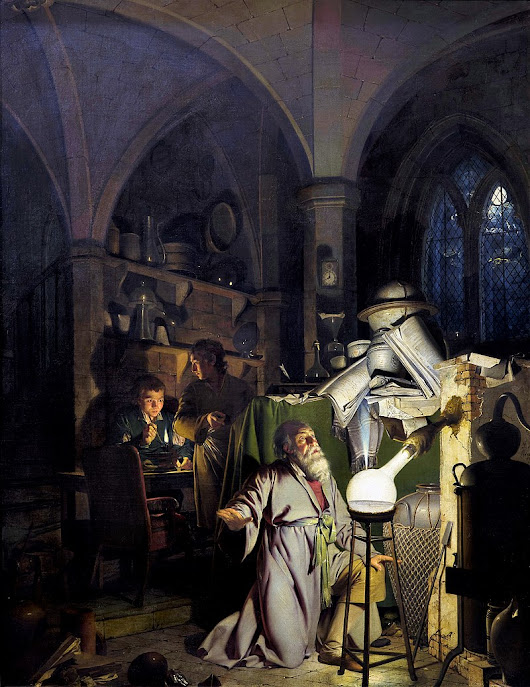
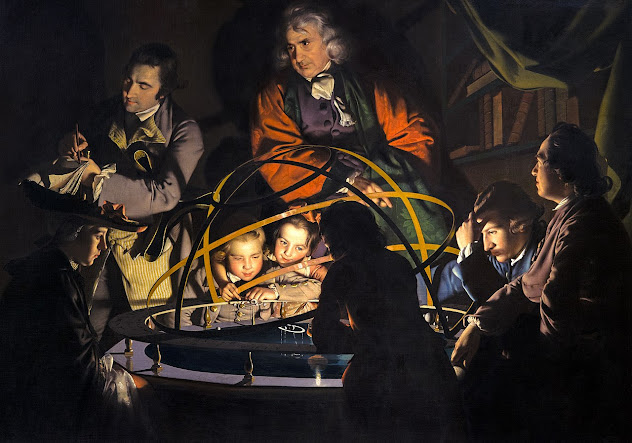
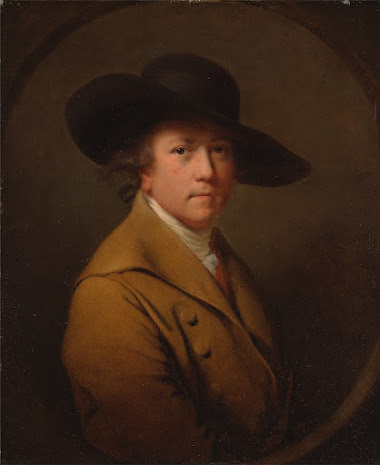
    Joseph Wright of Derby (1734 - 1797) lived through the era of the industrial revolution and the beginning of Romanticism.  I didn't live back then, but from what I have read, his pictures do a good job depicting that era and are good art in general.  Here is a self-portrait from 1780: 
    

The Alchemist Discovering Phosphorus

An experiment on a bird in the air pump: 


A philosopher lecturing on the orrery:


In these two pictures, Wright depicts the beginning of the time when science and scientific thinking was beginning to be part of ordinary people's lives.  And even the cruelty it could bring (as I understand it, the bird is suffocated as air is pumped out of its container).  The picture of the alchemist also shows the earlier era when science was properly called natural philosophy. 

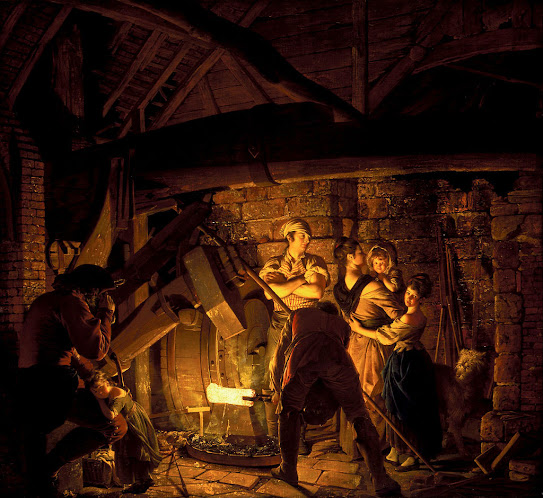
An Iron Forge:


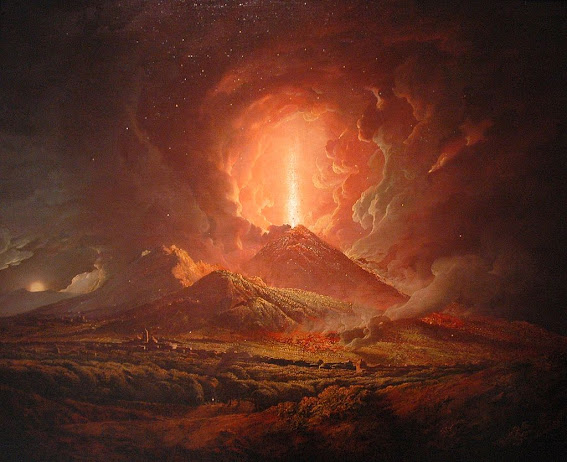
The Iron Forge is another painting showing technology.  In addition to these, Wright painted landscapes in a Romantic manner. 

Vesuvius from Popsilio:


Vesuvius from Portici


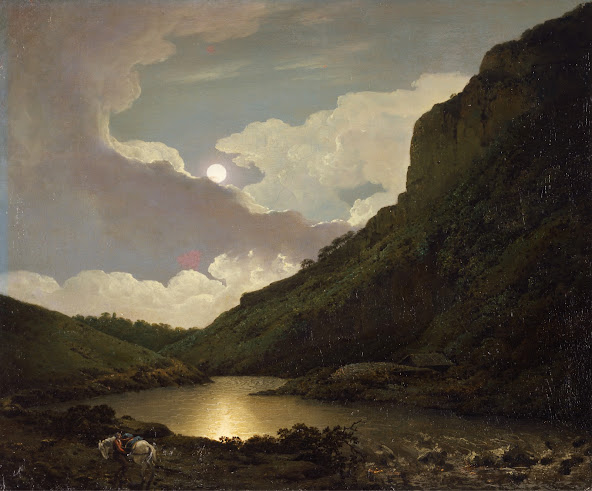
Matlock Tor by Moonlight


An idea inspired by a dream

     Recently, I had a dream that a person was granted a wish by a wizard and that as a consequence of the wish, he gained the power to absorb matter into his body, and become larger and larger.  When I woke up, while still in a semi-dream mode of thinking, I started down a train of thought that eventually led to thinking about how ancient peoples associated giants with mountains, such as believing that a giant was trapped under a mountain or that a sleeping giant had become a mountain.  

    And this also relates to how ancient people personified the world: they viewed the entire world as alive and not only alive, but anthropomorphic: for example, a mountain was thought of as something like a type of enormous human being.  

    Then later, we have the Medieval view, where rocks and mountains were viewed as part of the Great Chain of Being: they have their place in Creation but are not living.  However, they were not considered entirely dead, since they are a part of Creation as a whole and are connected by their place in the chain to living beings.  

    Later still, we have the view of scientific thought, that mountains are indeed completely lifeless matter, they are merely a formation made of up of rocks and minerals.  

    Then in the mid twentieth century, in his unfinished novel The Notion Club Papers, J.R.R. Tolkien wrote about the character Ramer, connecting his thoughts with a meteor.  Ramer talks about how there is not much freedom as we would consider in many places in the universe, just long waiting for something to happen, such as a slip between rocks such as an earthaquake or shift.  

    In this story, Tolkien tries to imagine the consciousness of a rock, but rather than anthropomorphizing it, he considers it to have a different and more restricted mode of consciousness than a human being.  

    Following Bruce Charlton, I consider Tolkien in the lineage of Romanticism because he, while living in the modern world, tried to move past the despiritualized and mechanistic thinking characteristic of our era. 

    From this perspective, we can then see a development in thinking about non-human parts of the world, that follows the development of consciousness, traced out by thinkers such as Rudolf Steiner and Owen Barfield.  First a spiritualized mode of consciousness, viewing the world as alive (and anthropomorphized), then the Medieval form of consciousness, then scientific thinking viewing the world as dead, and finally Romantic consciousness, which seeks to respiritualize our thinking, but in a more free manner than the older form of consciousness.  

    I wonder if in the earlier anthropomorphic way of thinking about the world, human consciousness was rooted in the human.  In the course of becoming more independent, people gained a greater ability to imagine different modes of consciousness from the human: to envision that animals, plants, or the sun are alive, but have consciousness of a very different quality than human beings.  In other words, the releasing of restrictions from consciousness gave it a greater flexibility, though this flexibility has come with other consequences: greater freedom to think less human thoughts can also be dangerous (as we see all around us).

Scattered thoughts on Homer, Virgil, and Dante

    Partially inspired by William James Tychonievich's post "Dante in the wood", I have been listening to works by these three authors over the past few months: Homer's Odyssey, Virgil's Aeneid, and Dante's Divine Comedy.  

    In a sense, these authors are successors to each other; though separated by centuries.  And I think this was conscious on their part.  For instance, the Aeneid can be thought of as the Illiad and the Odyssey all in one, except the part describing a voyage is first and part describing a war is second, reversing Homer.  And of course, Dante has Virgil guide him through Hell and Purgatory.  

    All three address the afterlife in some way.  When Odysseus goes to the underworld, he sees that except for the shades in torment, such as Tantalus, most of the people lead a shadowy, ghostly existence without being aware of much.  Only Tiresias among all the shades retains his wits.  However, at the end of the poem when the suitors descend to the underworld, they are greeted by the other shades and speak to them.  In any case, it was envisioned that existence would be much diminished.  

    I found it particularly striking that even the women who had children by the gods are down there in the underworld while the gods are up on Olympus.  We only here of three people who escape: Hercules who became a god himself and Menelaus and (presumably) Helen who will go to the Elysian fields.

    Virgil's depiction of the gods is more self-consciously poetical than Homer's, to the extent that I do not think he believed in them in a mythological way as Homer did.  I think the section of the Aeneid, when Aeneas goes to the underworld represents something close to Virgil's true religious beliefs.  He extends Homer's vision by separating the underworld into a section for the egregious wrongdoers, the city of Dis, and one for the righteous dead, the Elysian fields.  Furthermore, some souls undergo purgation for the wrongdoing they have done in life and then are reborn on Earth.

    For Dante, nearly the entire poem concerns the afterlife.  One thing I noticed about Dante is that while his poem is entirely in agreement with certain beliefs, such as that pagans cannot go to Heaven, he includes certain things in his poem that are somewhat of a different character.  For instance, even though Virgil is condemned to Limbo for eternity, he is allowed to accompany Dante all the way through Purgatory, even briefly to the Earthly Paradise at the top.  Also, the pagan Cato of Utica is the doorkeeper of Purgatory and so will be saved at some point.  

    This relates to something that Bruce Charlton has written about C.S. Lewis and J.R.R. Tolkien in that their publicly professed beliefs were circumsribed within certain limits, but in their stories, they explore ideas that go somewhat beyond those.  

    In any case, thinking through these three poems and how each expands on the others, adding more to the understanding of what happens after death, even Dante, with is extraordinary accomplishment is missing something.  In particular, he is missing the importance of freedom.  

    Here is what I mean by that.  Mortal life is brief in the grand scheme of things.  And during the course of this life, we have the opportunity to learn and the freedom to choose.  And it goes beyond those two words, those are two particular qualities, but there is a paricular character to life on Earth that is believed to be absent afterwards, although it is not easy to capture fully in words.

    This is expressed in various ways, such as the idea that the angels were given a brief stretch of time after their creation, when they could choose for or against God but after choosing, they were locked into their choice after that.  And there is a similar idea for human beings, that humans beings can choose Heaven or Hell but after that, there's no more room for choices.  And the way this seems to be understood is not that choice is taken away by some external means, but that there simply is no more need for it.  

    But need we think this?  It is true that in our experience of Earthly life, freedom and sin go hand in hand.  But is it possible both to make a permanent committment to God at death and in doing so moving to a state where sin is impossible, and moving forward towards more freedom?  

    One could interpret the story of the Garden of Eden as saying that Adam and Eve had a short period of time to exercise freedom and then once that decision was made there was no more room.  But the story doesn't actually say that explicitly.  It is certainly a valid interpretaion, but it is not the only one.  Another possibility is that in making a decision, Adam and Eve could have lived a type of life which is very difficult to imagine but not thereby impossible: a life both without sin and with freedom.   

     Someone who could write that kind of story, would indeed be Dante's successor.  

Articulation, belief, and intuition

     Recently this video was brought to my attention.  It found it helpful to hear the narrator think through the issues he discusses because it shows another person's thinking process as he approaches the issues of the present time.  One insight in particular that I thought was good is that he mentioned that you do not have to know in detail how all the algorithms of Twitter work to know that it is a net negative for many people that use it.  

    And of course this goes far beyond Twitter.  I haven't been able to locate this quote, but in either one of his books or on his blog, Edward Feser mentioned Richard Dawkins's famous statement in his book The God Delusion that Dawkins hoped his book would convert any religious person who read it to atheism.  Feser made the point that in general, that isn't the way people change their beliefs.  It is rare to have a single, definitive experience or argument that changes one's beliefs (Saint Paul would be one of the classics examples).  Rather, over a period of time, lots of little things add up and after a while, one realizes one has changed their beliefs.  C.S. Lewis writes about this in his autobiography Surprised by Joy.  He mentions the process of becoming a Christian and writes the following about the moment of conversion, while traveling to the Whipsnade zoo with his brother: 

    "I know very well when, but hardly how, the final step was taken.  I was driven to Whipsnade one sunny morning.  When we set out I did not believe that Jesus Christ is the Son of God, and when we reached the zoo I did.  Yet I had not exactly spent the journey in thought.  Nor in great emotion.  Emotional is perhaps the last word we can apply to some of the most important events.  It was more like when a man, after long sleep, still lying motionless in bed, becomes aware that he is now awake."

    And what this means is that, frequently, when asked about why one believes or disbelieves something, one can give one reason or a few reasons, but none of them will be convincing to the questioner.  Partly because no reason was convincing by itself and partly also because one cannot present the experience of a process of months or years in minutes.  Another reason is that different people find different reasons convincing.  

    The important thing is that it is possible to know that one has good reasons for a belief but to not be able to articulate them or convince with them for a variety of reasons.  

    And this has particular relevance to the present time.  The System has all kinds of easily articulable reasons for everything.  They have statistics, canned responses, supposed experts, etc.  And so, it is easy for someone to give a reason for why they believe the System point of view.  In terms of validity, the reason may be completely worthless, and it may even just be for someone to convince themself, but the psychological effect of having ready answers for everything can be very powerful.  

    Also, because there is so much that it is difficult to know for sure about various issues (because we don't have personal experience of them), it isn't always easy to give a reason why we view something as good or bad.  

    And this particularly relates to the peck.  I believe that in some people minds, the connection of the peck to cloned fetal cells functioned in this way.  It is true that it shows the extraordinary level of corruption within medical research, but because this is a specific, articulable reason for opposition to the peck, many people both for and against wrote as if it was the only reason.  That if this reason could be refuted, then there would be no more grounds for opposition to the peck.  But, not only is this not the only reason for opposition to the peck, opposition goes beyond merely a list of reasons.  

    It really comes down to intuition and discernment.  One can know that the peck is wrong and can have reasons to believe it, but the opposition really comes from the understanding that comes from and goes beyond those specific enumeration of reasons.  

The Hall of Mirrors Effect

     When people read or hear something from different sources, they are inclined to take more notice.  In particular, if a particular idea or observation is stated by multiple people, then people are more inclined to believe it or at least give it consideration.  One reason for this is perceived social consensus; if the idea is stated by more individuals then maybe it is becoming more important in the social sphere.  

    But there is another reason, which is that if more people notice something, then it is more likely to really be there, not just a mistake of one person.  Or, if multiple people ascribe to a particular belief then it is less likely to be the result of a single person's idionsyncracies.  

    The key assumption is that these observations and beliefs are independent.  For example, if every day during seven days, a different person tells you they encountered bigfoot, then you would take notice.  Because it is seven separate sightings.  On the other hand, if you found out that only one of these people claimed to actually see bigfoot, but the others were just in the area at the time, then it is not seven sightings but one.  And in that case, whether to believe it or not depends on how reliable the one person's testimony is.  

    Similarly, there are many sources of news or information which really all come from one source, just amplified many times.  Like a hall of mirrors that reflects the same image many times and creates the illusion that there are many objects, one source of unknown reliability is repeated multiple times, creating the illusion of many independent sources.

    Social media is particularly bad with regards to this.  Because it gives people the illusion that everyone they know believes something or knows something when in reality they are just repeating mass media narratives that they know nothing about and haven't thought about other than to give official sources the benfit of the doubt.  A feature of human psychology that is natural and helpful in normal situations is hijacked.   

    Sometimes, when I read unusual opinions or beliefs in multiple places and start to take them more seriously, I sometime wonder whether if I'm fooling myself and it's just the hall of mirrors effect.  It's worth taking into consideration, but I think it is definitely far less than with leftist content.  Bruce Charlton has a post which I haven't been able to find again where he writes that left-wing bloggers are pretty much interchangeable.  It's not about expressing their individual beliefs or knowledge, it's about advancing the narrative.  By constrast, non-leftists think about what they write for themselves.  So, even if an idea comes from a single source, different people will write about it with different analyses and may agree but via different lines of thought.  

    Before the invention and proliferation of mass media, the hall of mirrors effect was far less common.  But at this point, when so much of our information comes second hand, it's good to think about from where the information originated. 

A relevant story

    This is a story from an article about the Russian Orthodox Saint John Maximovitch.  It's somewhat long, but I would recommend reading the whole thing.  Here was a story from the article, (which was originally written in 2012).  The relevance to the present time is apparent:

    "Vladyka's [John Maximovitch] constant attention to self-mortification had its root in the fear of God, which he possessed in the tradition of the ancient Church and of Holy Russia.  The following incident, told by O. Skopichenko and confirmed by many from Shanghai, well illustrates his daring, unshakable faith in Christ.  'Mrs. Menshikova was bitten by a mad dog.  The injections against rabies she either refused to take or took carelessly ... And then she came down with this terrible disease.  Bishop John found out about it and came to the dying woman.  He gave her Holy Communion, but just then she began having one of the fits of this disease; she began to foam at the mouth, and at the same time she spit out the Holy Gifts which she had just received.  The Holy Sacrament cannot be thrown out.  So, Vladyka picked up and put in his mouth the Holy Gifts vomited by the sick woman.  Those who were with him exclaimed: 'Vladyka, what are you doing!  Rabies is terribly contagious!'  But Vladyka peacefully answered:  'Nothing will happen; these are the Holy Gifts.'  And indeed nothing did happen.' "

    This is an incredible story.  I do not have much to add except that Christians (including those who do not formally canonize saints or who are not Orthodox (for instance, I myself am a Roman Catholic)) should think seriously about the beliefs and actions of those who are exemplars of their faith.  Even if we are not at their level, we can learn from them.  For instance, not everyone needs to or can go out into the desert and become a hermit, but the fact that such people did exist and the nature of their actions gives us much food for thought.

Metaphysical Voting

    One of Bruce Charlton's classic posts is "The evils of voting."  In this post, Charlton argues that there is no reason that voting should be a "gold standard" of making decisions: 

    "Where did people get the idea that voting was an acceptable - let alone the best and only, way to make decisions?  
    
... 

    There is no magic about majority voting, no 'wisdom of crowds', no place for the operation of divine or individual inspiration - neither the safety-first gut-feeling veto of requiring unanimous and full community assent to change, nor for the inspirational decisiveness of the gifted individual to lead the consenting (or acquiesing) group on the basis of superior wisdom, insight, foresight.

... 

    To rely on majority voting is fundamentally unserious; it is to regard life as essentially soft and sustaining, to regard life as unreal and something not requiring of us correct decisions and right behavior."

    I agree with this post, that there is nothing intrinsically good about voting.  It is just one method among many of making decisions; in some situations it is good, in others it is not.  Voting works best when used among a relatively small number of well-informed and honest individuals to force decisions, where something needs to be decided, but the decisions are only of small or moderate importance.  
    
    In the post, Charlton also mentions that a two-thirds majority makes more sense than a simple numerical majority because in this case those who agree outnumber those who disagree by two to one.  One could also imagine this principle being applied to an organization such that nothing can be decided by voting unless there is a two-thirds majority.  

    It is also mentioned that voting can fool human beings:

    "We hoodwink human psychology by forcing pre-commitment to the unknown outcome of majority voting as intrinsically correct."

    Even though in actuality, voting is not the same as making a specific decision, psychologically, the act of voting causes people to feel invested in the process as if they did agree. 
        
    In addition to political voting, however, people also vote by their actions, which determines what kind of society one lives in.  And this is somewhat analogous to voting because these actions are aggregated to influence people's lives.  But unlike voting, it is not one vote per individual because the influence of some matters more than others, also, one can "vote" multiple times depending on one's choices.  In some respects they may even cancel out.  
    
    But even apart the material effects, I believe that our actions and thoughts are a kind of metaphysical voting.  If we really want something, and act according to that desire, then we are metaphysically voting for that which we desire.  But if we get it, it may be as the thing really is, not as we imagined it.  
    
    This also relates to prayer, prayer is a kind of metaphysical voting as well.  One might think of the natural question "God already knows what we need, so why do we have to ask?"  I believe one reason is that by asking, one is making an active investment of will.  

    Like voting by action, metaphysical voting is not "one man, one vote" either.  For example, the "vote" of a saintly hermit, i.e., his prayers and actions, has a far greater effect on his society than those of an ordinary person.  Not only because of his virtue, but also because such a hermit is more closely aligned with God and Creation, so he would know better what to vote for, so to speak.    
    
    This relates somewhat to the peck.  In an article from a Greek Orthodox hieromonk transcribed in this post by William James Tychonievich, there is a suggestion that there will eventually be seven pecks.  I can't say whether the number is literally true, but this goes along with the concept of metaphysical voting.  Many people have received the peck without fully thinking through what it means.  But the side of evil does not want that; they don't just want people to receive the peck, they want people to identify with it.  Their goal is that with each further dose, people will with increasing consciousness metaphysically vote for a worse world.   

    However, and this is the importance of metaphysical voting, one can always cast a vote for the side of good.  And things can always be better.  Consider the story of Adam and Eve in Genesis 3:8-15: 

    "And when they heard the voice of the Lord God walking in paradise at the afternoon air, Adam and his wife hid themselves from the face of the Lord God, amidst the trees of paradise.  And the Lord God called Adam, and said to him: 'Where art thou?'  And he said: ''I heard thy voice in paradise; and I was afraid, because I was naked, and I hid myself.  

    And he said to him: 'And who hath told thee that thou wast naked, but that thou hast eaten of the tree whereof I commanded thee that thou shouldst not eat?' And Adam said: 'The woman, whom thou gavest me to be my companion, gave me of the tree, and I did eat.'  And the Lord God said to the woman: 'Why hast thou done this?'  And she answered: 'The serpent deceived me, and I did eat.'

    And the Lord God said to the serpent: 'Because thou hast done this thing, thou art cursed among all cattle, and the beasts of the earth: upon thy breasts shalt thou go, and earth shalt thou eat all the days of thy life. 

    I will put enmities between thee and the woman, and thy seed and her seed: she shall crush thy head, and thou shalt lie in wait for her heel.'  "

    When God spoke to them, rather than acknowledging that they had done wrong and repenting, Adam and Eve each tried to deflect the blame from themselves.  And they could have even repented before that, if they had gone to meet God rather than hiding themselves.  Of course, the story does not say what would have happened then, but we can speculate that things would have been better.  There would still have been a great price to pay, but things would not have been so bad.  

    And there are many situations in this world where even if things are bad, even if much that is bad cannot be averted, the end result can be much better by making the right decision at the right time.  
 
    And for this reason I do not believe that there should be enmity between the pecked and the unpecked.  Certainly, one should interact as little as possible with those who believe in and enforce the current totalitarianism.  Discernment along these lines is always necessary.  By all means, let there be enmity between human beings and the serpent, between those of us on Earth and the "rulers of this present darkness."  But for one own family, or close friends, or even acquaintances who mean one no harm, there is no reason for such.  

    The more that cast a ballot for God and Creation (and there are many ways to do this), even if they supported this totalitarianism before, the better things will be spirituallly, and I believe, materially as well.

Some thoughts on the Fermi Paradox

    The Fermi Paradox is the idea that despite the large number of stars (and hence, presumably planets), we have so far not seen indications of life on another planet.  The linked encyclopedia article lists four points: 

    "There are billions of stars in the galaxy that are similar to the Sun, many of which are billions of years older than Earth.  

    With high probability, some of these stars will have Earth-like planets, and if the Earth is typical, some might develop intelligent life. 

    Some of these civilizations might develop interstellar travel, a step the Earth is investigating now. 

    Even at the slow pace of currently envisioned interstellar travel, the Milky Way galaxy could be completely traversed in a few million years."

    The first point is true and the second is reasonable.  In fact, with the Kepler telescope, it was found that there were indeed many planets orbiting stars.  But the third and fourth points are much more of a leap.  

    The article itself says: 

    "While the current understanding of physics rules out the possibility of faster-than-light travel, it appears that there are no major theoretical barriers to the construction of 'slow' interstellar ships, even though the engineering required is considerably beyond our present capabilities."

    To begin with, if one wanted to build an interstellar spaceship (even travelling slower than light), it would have to be completely self-sufficient, since there would be no resources to rely on.  (Unless someone figured out a way to collect and synthesize abient matter in space or to stop on another planet or asteroid with resources).  Nonetheless, the standards for self-sufficiency are much higher than the meaning of that phrase on Earth.  Furthermore, there must be some way to maintain and repair the vehicle over a period of hundreds or thousands (or even millions of years).  

    Even an unmanned interstellar probe would either have to be constructed so as to last for thousands upon thousands of years or be self-repairing in some way.  Even if a civilization made it its mission to send out vast numbers of probes, once the probes drift far enough away from the civilization and each other after millions of years, one might end up with widely separated, inert pieces of space debris, rather than probes that fill up the galaxy.      

    This is a similar situation to the use of models involving randomness and probability.  Probability is useful in modelling certain situations, but it is a huge leap to go from that to suggest that it can model everything.  Likewise, science and engineering have caused immense changes on Earth, yet there is no justification to go from "science can do a lot" to "science can do anything".  

    This is not to say that interstellar spacecraft are impossible, in fact, I do believe they are could be built.  One could perhaps classify the Voyager probes as such.  But in practice the task may be so difficult that it never occurs.  

    Beyond the practical issue, however, is the contrast between different worldviews concerning the purpose of life in the universe.    

    One view is that the universe is something like a bunch of blocks to be rearranged and that it's just a matter of figuring out how to do this.  Furthermore, according to this view, the natural and obvious purpose for a civilization is to use technology to colonize and spread throughout the galaxy. 

    The other view says that life is in this universe for a spiritual purpose and its ultimate destiny lies outside the material universe.  Technology is something that is possible and is allowed, but the constant advancement of technology is not the driving principle of the universe.  

    One way to illustrate the different ways of thinking is to consider two different ways of envisioning an intelligence beyond the human.  In the present day, this is frequently a computer or machine.  It exceeds human intelligence by speed and efficiency.  In the Middle Ages, the idea of a superhuman intelligence was an angel, which was viewed as exceeding human thinking in the opposite way.  Rather than processing faster than humans, there is no processing going on at all.  An angel was envisioned as having a purely intuitive mind, so while a human being might need to find the truth by laborious reasoning, an angel would jump directly to the truth by insight alone.

    From the first point of view, the Fermi paradox is indeed a paradox.  But according to the second, it is not at all.  Beings on each planet are incarnated for different reasons and the reason planets are far apart is so that there can be no interference between them.  In this case, the universe is constructed according to principles that at the most fundamental level bear more resemblance to what we would call the mental or the spiritual than to the physical.  In that case, technology is just one aspect, rather than being the be all and end all of a civilization's existence.

    Jacob dreamed of many angels going up and down a ladder, yet even in the Bible, appearances of angels are few and far between.  Might not some of them have been going to other planets?

    As far as my personal beliefs go, due to considerations about the vast number of stars and the plausible existence of many planets, I do believe that there are beings on other planets, some of whom we would call intelligent.  They might be very strange, however.  Tolkien has some interesting ideas in his Notion Club Papers, which envisions a planet of something like living metal, tended by some sort of incorporeal elves, a planet inhabited by living crystal, and a planet made as the realization of an act of contemplation.  (Some of these passages are quoted in this post).  

    However, I do not think that there will ever be widespread interstellar travel as envisioned in the Fermi paradox because I do not believe that is not what the universe is for.  Though I could certainly imagine solar systems with multiple inhabited planets and travel between those.  

The real AI agenda

    On a post  by Wm Briggs, about artificial intelligence, a commenter with the monniker "ItsAllBullshit" writes:           ...